Agentic workflows
Use the two-axis framework to decide whether your problem needs simple automation, governed operations, or full agentic autonomy, and what each one costs to run.
Start reading

Frameworks, field notes, and architecture notes on agents, safety, memory, evaluation, governed autonomy, and the economics of systems that have to survive real users.
Start here by problem
Use the two-axis framework to decide whether your problem needs simple automation, governed operations, or full agentic autonomy, and what each one costs to run.
Start readingHow agent memory should actually work: trust-gated saving, supersession instead of deletion, lifecycle hooks, compression, reranking, and the protocols that keep context useful at scale.
Start readingA high-trust mental-health AI case study: a risk-detection policy, safety decoupled from the conversation, and an audit-ready architecture built to hold up under scrutiny.
Start readingLessons from pushing the limits of safety and security of an agent on OpenClaw, and how open-source project maturity factors into building a trustworthy agentic employee.
Start reading
Framework · May 26, 2026
Two axes, the problem a system solves and the identity it is allowed to assume, sort any AI initiative into four quadrants. Use it to decide what to buy, what to build, and what will survive contact with production.
Read the piece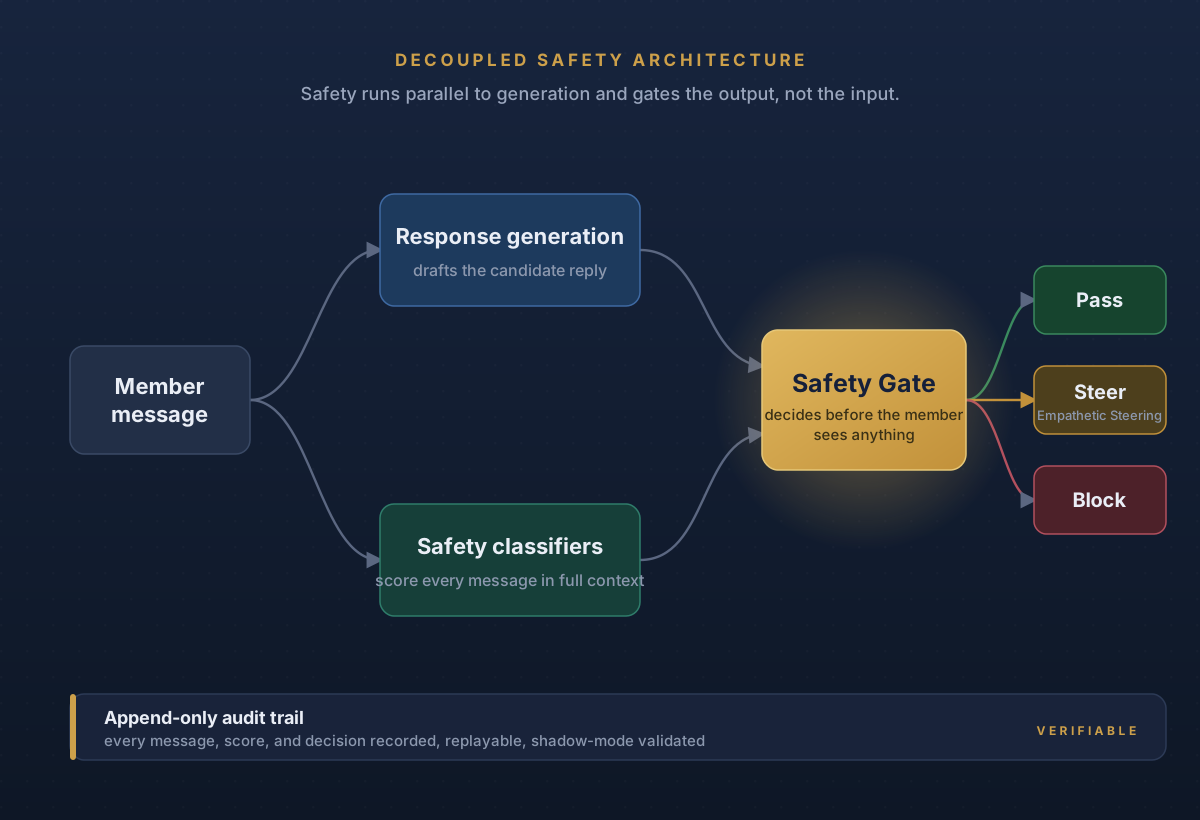
Case study · April 16, 2026
How safety becomes an operating system in a high-trust mental-health context: a risk-detection policy, an architecture that decouples safety from the conversation, audit-ready data infrastructure, and a validation discipline that holds up under scrutiny.
Read the piece
Architecture · March 15, 2026
Vector search, knowledge graphs, task trackers: most agent memory systems leave curation and poisoning risk as the operator's problem. A side-by-side look at Mem0, Letta, Zep, Graphiti, Cognee, and an alternative built around trust-gated saving and supersession instead of deletion.
Read the piece
Economics · April 26, 2026
Selling AI outcomes instead of software seats means someone absorbs the compute, and SaaS-era margins don't survive that. Seven places cost hides, from runaway orchestration loops to the human review "autonomous" systems quietly need back.
Read the piece Protocols · March 25, 2026
SECOM (extractive compression that preserves evidence), ACE (playbook-driven reranking over raw retrieval), and RLM (MapReduce orchestration for long-context summarization): three research results turned into composable lifecycle hooks for agent memory. Where each plugs in and what it does in production.
Read the piece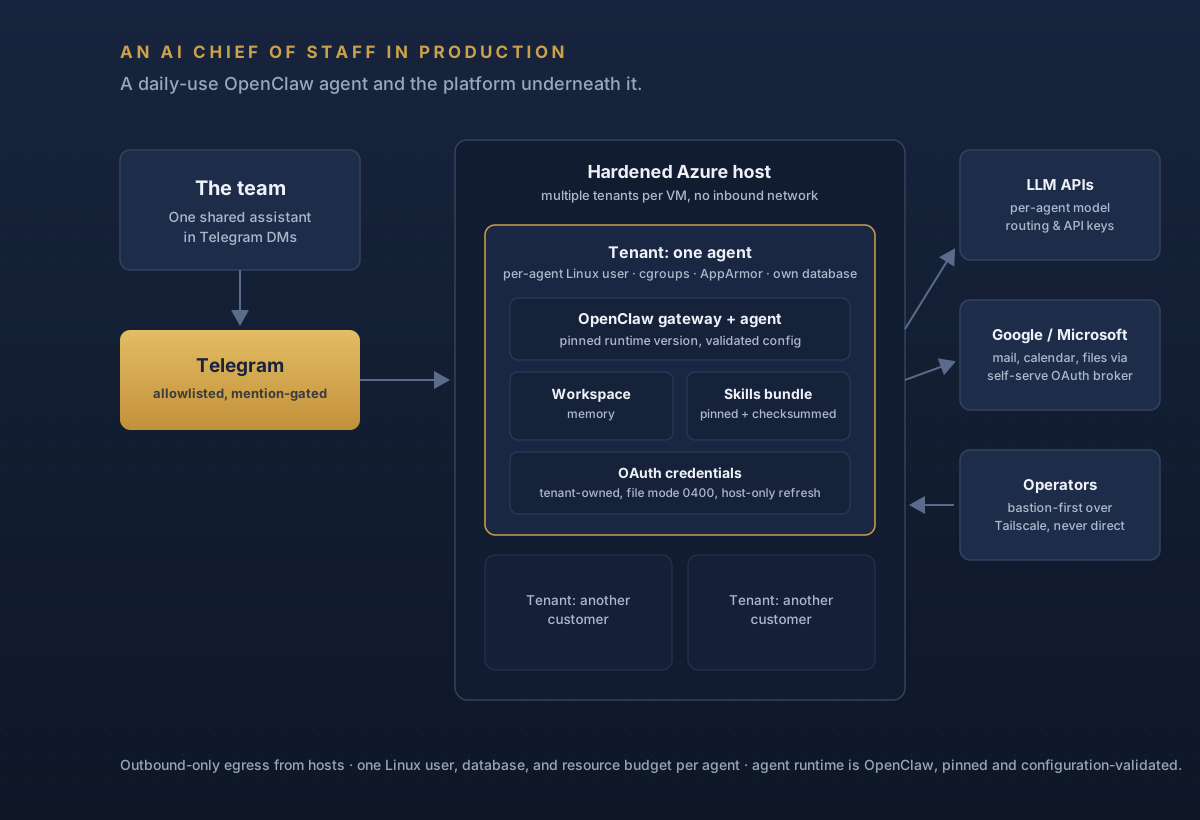
Series · 4 parts
What running a managed AI assistant on the OpenClaw runtime for a real customer actually taught: inbox access and tenant isolation as safety controls, runtime stability as release governance, and the operational cost of betting on a fast-moving agent runtime.
This is the kind of judgment I bring to every engagement: spotting the failure mode before it reaches a customer. See how the work actually runs.
See how engagements workNewsletter notes
More time-sensitive opinions, release notes, and working updates. The permanent pieces above are kept tighter; these link out to the newsletter.
Substack · May 13, 2026
AI gives humans leverage. It is still unclear whether that leads to freedom, consolidation, or exhaustion as human verification becomes the bottleneck.
Read on SubstackSubstack · March 28, 2026
A release dispatch on connecting FAVA Trails trust-gated memory to Codev development protocols and artifact workflows.
Read on SubstackSubstack · March 10, 2026
A newsletter note on FAVA Trails lifecycle hooks and production protocols for keeping agent memory useful as it scales.
Read on SubstackSubscribe for field notes on production AI, agents, safety, evaluation, memory, and governed autonomy.